
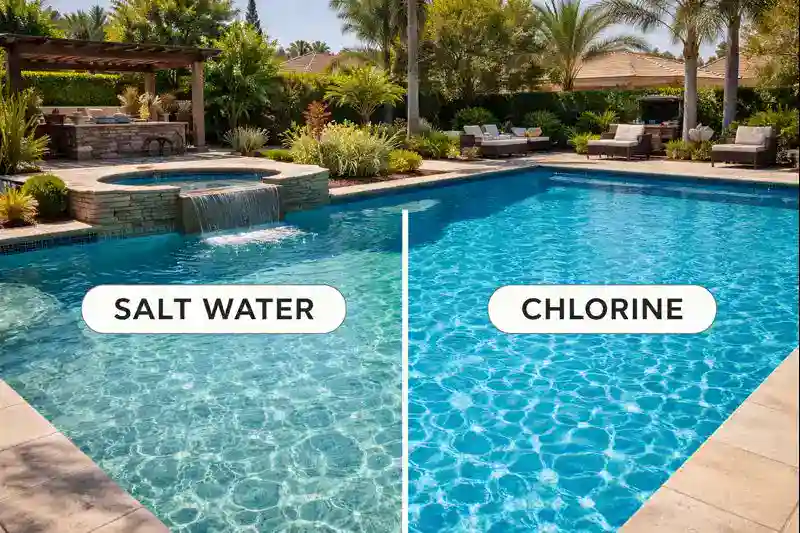
If you’re planning a new pool in the Inland Empire, you’ll probably hear this question early on: “Should we do salt water or a traditional chlorine pool?” Homeowners in Riverside, Rancho Cucamonga, Ontario, Fontana, Moreno Valley, and nearby cities ask us this all the time—usually right after we talk about shape, spa add-ons, and where the equipment will go.
Here’s the straightforward truth: both systems can be great. And both can be frustrating if they’re set up poorly or ignored for long stretches. What matters most is choosing the system that matches your lifestyle and then building the pool correctly so the system can do its job without constant babysitting.
Quick Myth-Buster: Salt Pools Still Use Chlorine
Salt water pools aren’t “chlorine-free.” They’re just a different way of producing chlorine. A salt system uses a salt chlorine generator (often called a “salt cell”) to convert dissolved salt into chlorine as the pool water circulates. A traditional pool uses chlorine you add yourself—tablets, liquid, or granular.
Both systems sanitize water. Both require balanced chemistry. If you want a public, science-based overview of how pool sanitation works, the CDC Healthy Swimming program is a helpful starting point.
What Inland Empire Weather Does to Pool Water (and Why It Matters)
The Inland Empire isn’t coastal. We get long stretches of intense sun, hot days, and warm nights—especially in places like Riverside, Moreno Valley, Fontana, Rancho Cucamonga, and Ontario. That heat and UV exposure affects how fast chlorine is used up, how quickly algae can bloom if levels drop, and how frequently you’ll need to test and adjust water balance.
So, when homeowners ask “Which system is easier?”, what they often mean is “Which system is more forgiving during our summers?” Salt systems tend to keep sanitizer levels more consistent, but traditional pools can be just as manageable if the routine is tight and the equipment is sized correctly.
Salt Water Pools: Why Homeowners Like Them
1) More “Even” Water Day to Day
Because a salt system produces chlorine steadily (when the pump runs), many homeowners experience fewer chemical swings. It’s not magic—you still need to test and balance—but it can feel more stable than relying on periodic manual dosing.
2) The Water Often Feels Better
A lot of people describe salt water as softer. Eyes may sting less, and skin can feel less dry—especially for families swimming often. This is one reason salt systems are popular in busy households where the pool gets used constantly.
3) Less Chemical Storage and Handling
Salt systems can reduce how often you’re buying, storing, and handling chlorine products. You’re still doing water checks, but the weekly routine can feel less “chemical heavy.”
4) Great Pairing with Automation
If you’re already considering automation (remote controls, scheduled pump speeds, integrated spa modes, etc.), salt systems fit nicely into that mindset: stable output, predictable operation, fewer surprises.
Salt Water Pools: The Real Trade-Offs (Not Dealbreakers—Just Good to Know)
We’re not in the business of scaring homeowners away from salt. We build a lot of salt pools. But we also want people choosing salt for the right reasons.
- Higher upfront equipment cost: You’re adding a generator and salt cell.
- Salt cell replacement: Cells wear out over time. Lifespan depends heavily on water balance and how hard the system has to work.
- Material and craftsmanship matter: Salt water can be more demanding on certain finishes and metal components if the pool isn’t built and bonded correctly. Good construction prevents most of the long-term issues people worry about.
If you’re curious about safe handling and best practices around pool chemicals and water health, the U.S. EPA and CDC provide public guidance that aligns with the basics we encourage homeowners to follow.
Traditional Chlorine Pools: Why They Still Make Sense
1) Lower Initial Equipment Cost
A traditional pool usually starts with simpler equipment. If you’re trying to keep the build cost tighter at the beginning, this can be appealing.
2) Familiar Routine (and Less Specialized Equipment)
Many homeowners are already comfortable testing water and adding chlorine. There’s no salt cell to maintain, and the system is more straightforward mechanically.
3) Easy to Adjust Quickly
If chlorine is low, you can correct it immediately. Some homeowners like that direct control instead of relying on a generator to “catch up” over time.
Traditional Chlorine Pools: Where Homeowners Feel the Work
- More hands-on dosing: You’re typically adding chlorine products more regularly.
- More visible swings if testing slips: If you get busy and skip a week, the pool can let you know—especially in the hottest months.
- Chemical storage: You’ll store and handle chlorine products more often.
Side-by-Side Comparison (The Stuff Homeowners Actually Care About)
| Category | Salt Water Pool | Traditional Chlorine Pool |
|---|---|---|
| How it sanitizes | Generates chlorine from salt via a cell | Chlorine is added manually (tabs/liquid/granular) |
| Upfront equipment cost | Higher (generator + salt cell) | Lower (simpler setup) |
| Weekly effort | Often lower day-to-day; still requires testing/balancing | Often more hands-on; testing + dosing is key |
| Water feel | Often softer, less “chlorine smell” | Can feel stronger if levels swing |
| Long-term parts | Salt cell replacement over time | No salt cell; fewer specialized components |
| Best fit for | People who want consistency + automation | People who want simplicity + lower equipment cost |
What We Look at When We Help You Decide
When a homeowner asks us which system we recommend, we don’t answer based on what’s trendy. We look at your actual use case. A few questions we ask:
- How often will you swim? Daily in summer, or mostly weekends?
- Do you have kids, pets, or lots of guests using the pool?
- Do you travel often and want the pool to be “low drama” while you’re gone?
- Are you adding a spa, water features, or automation?
- Do you want to do the maintenance yourself, or hire pool service?
Those answers usually make the decision pretty obvious.
Where This Fits Into the Bigger Backyard Plan
Most pool projects in the Inland Empire aren’t just “pool-only.” Homeowners often upgrade the entire outdoor space at the same time—because once equipment is on-site and the yard is open, it’s the smart moment to do it.
Common add-ons we plan alongside pool builds include:
- Pool + spa combinations (a very popular choice)
- Pool decking and coping in concrete or pavers
- Outdoor kitchens and built-in BBQ areas
- Lighting for safety and atmosphere
- Landscaping to soften the hardscape and finish the look
- Renovation/remodeling if you’re updating an older backyard
A Note on Water Use and Responsible Ownership
Owning a pool means being mindful of water—evaporation, splash-out, leaks, and refills. Inland Empire summers can increase evaporation, so smart equipment choices and good maintenance help. For broader statewide context on water planning and conservation, the California Department of Water Resources is a useful reference.
Bottom Line
If you want a pool that feels consistent and pairs well with automation, salt is a strong option. If you prefer lower upfront equipment cost and a simple, familiar system, traditional chlorine is still a solid choice. Either way, the biggest difference-maker isn’t the label—it’s the build quality, the equipment sizing, and a maintenance plan that matches real life.
If you’re planning to build a pool in Riverside or anywhere in the Inland Empire, we’re happy to walk your yard, talk through your goals, and help you choose the system that makes sense for your home—without the sales pitch.